How the London Eye Was Built
- Thursday February 12th 2026
Curious to know how one of London’s most iconic landmarks came to be? From laying the foundations to the grand opening, discover how engineers and builders turned a bold idea into the giant observation wheel we see today.
Who Designed and Built the London Eye?
Originating as an entry submitted in 1993 for a new landmark to commemorate the millennium in London, the London Eye was designed by architects David Marks and Julia Barfield of Marks Barfield Architects.
The initial planning of the London Eye took some time, as it faced several obstacles. In fact, Marks Barfield Architects ideated around 100 variations for the wheel structure before settling on their final design and receiving approval to start building the London Eye.
What Was Built: The Main Parts of the London Eye
What makes the London Eye’s construction so remarkable?
Built around a giant steel wheel (the rim) attached to a central hub and axle, its steel cables stretch from the hub to the rim, followed by two angled support legs and backstay cables that keep the structure stable. Then, around the rim, sit 32 glass passenger capsules, offering visitors sweeping views of the Thames and iconic London landmarks like St. Paul’s Cathedral and the Houses of Parliament.
Foundations: How the Base Was Built to Support the Structure
The London Eye’s construction is supported on just one side, so its foundations had to be strong enough to handle heavy loads and powerful winds. To achieve this, two main foundations were built, one for the angled support legs and another behind it to anchor the backstay cables. These foundations resist the weight of the wheel, the pull from the cables and the wind, keeping the entire structure safe and stable.
Making the Parts Before They Reach the Site
The London Eye’s construction wasn’t built from raw materials on site. Large parts were made in the Czech Republic, France, Germany, the Netherlands and Italy, and were delivered to the UK ready to assemble.
The steel rim came in multiple sections, the central axle in large pieces, and the cables were manufactured to exact lengths. Even the 32-passenger capsules were fully built before installation. This off-site preparation ensured accuracy, safety and speed during its construction.
Delivering the Components Using the River Thames
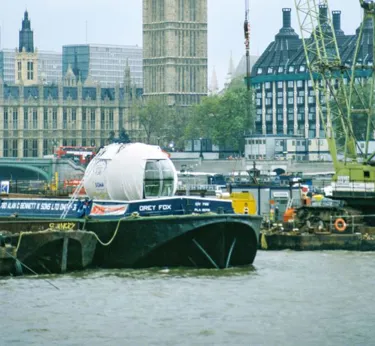
Many of the London Eye’s massive parts were too large for regular roads, so they were transported by barge along the River Thames. This included the steel rim sections, the central hub, as well as the huge axle. Using the river made delivery easier, safer and faster, allowing the components to arrive directly at the construction site ready for assembly.
Assembling the Wheel Flat Over the River
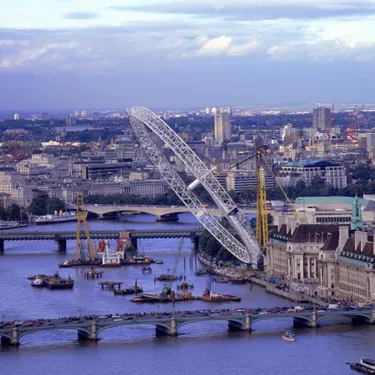
When constructing the London Eye, temporary platforms were built in the River Thames, and the London Eye was assembled lying flat, not upright. Steel rim sections were joined to form a complete circle, creating a giant wheel lying on its back. This method provided safer working conditions, made it easier to align the parts and gave engineers better control during assembly.
Installing the Centre and the Steel Cables
Once the wheel was fully assembled flat on the temporary platforms, the central hub and axle were carefully positioned in the middle of the wheel. This hub forms the core around which the wheel rotates. Next, steel cables were attached between the hub and the rim, acting like the spokes of a giant bicycle wheel. These cables were pulled tight to provide tension, which makes the structure strong and stable while allowing it to spin smoothly. By installing the hub and cables first, engineers ensured the wheel could be raised safely and would maintain its perfect shape under its own weight and the forces of wind.
Adding the Support Legs and Backstay Cables
Two large, angled steel legs were attached to support the London Eye, and strong cables were connected behind the structure to stop it tipping forward. Unlike most large wheels, which are supported on both sides, the London Eye is supported on just one side. This made construction more challenging, as it required careful planning to keep the wheel stable.

Lifting the Wheel Into Its Upright Position
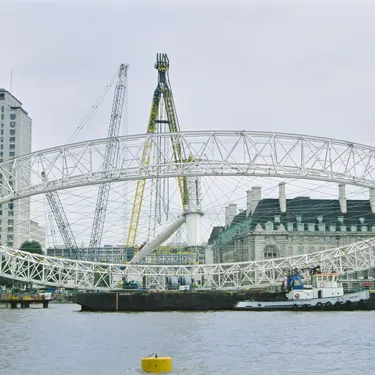
The fully assembled London Eye construction was then raised from a flat to a vertical position using robust hydraulic lifting systems. The lift was carried out slowly to control movement and loads on the wheel and cables carefully. The first attempt was paused due to an issue with temporary equipment, but once the problem was corrected, the second lift succeeded. After reaching its upright position, the wheel was permanently fixed to its foundations, ready for the final stages of construction.
Installing the Passenger Capsules
Once the London Eye was upright, the 32 passenger capsules were lifted into place and attached around the rim. Each capsule is designed to stay level using a motor system, so visitors remain upright as the wheel turns. The wheel rotates slowly, allowing people to board safely while enjoying panoramic views of London.
Power, Movement, and Safety Systems
Electric motors rotate the London Eye by pressing against the rim, turning the wheel smoothly. The slow rotation speed allows controlled boarding, so passengers can get on and off safely. Built-in safety systems ensure that doors only open at the platform and that the wheel can stop safely if needed, keeping every ride secure and reliable.
Testing and Opening
After the construction of the London Eye was completed around 1999–2000, engineers carried out thorough testing before it opened to the public. They checked the structure, the movement system and the capsule operation and safety controls to make sure everything worked perfectly. Once all tests were complete, the London Eye officially opened, giving visitors a safe and spectacular way to see the city from above.
Experience The London Eye Today
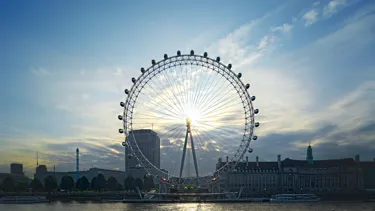
Now that you understand exactly how the London Eye was built and how its structure works, you should experience the engineering in person! Riding the wheel gives a clear sense of its scale, movement and construction from inside one of the capsules.
Buy London Eye Tickets