Real-world thinking for KS3: Using London as a launchpad for multi-subject learning
- Wednesday March 4th 2026
- Lesson Planning, School Trip, KS3
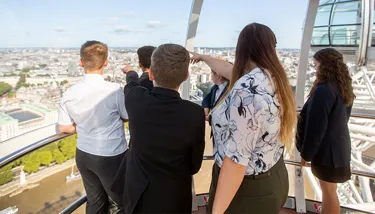
Imagine students scanning that iconic London skyline and pinpointing a landmark.
Working in pairs or small groups they head off to dig into its history, its architecture and its impact on contemporary London life. They find out how it’s working to improve sustainability and how many tourists flock through its doors each year. They compile a multimedia report, present their findings or debate with classmates about what they’ve uncovered.
They’re excited, engaged and enthusiastic.
Because, for a KS3 student, this style of multi-subject learning can be an incredibly powerful tool.
Not only have they ticked off multiple subject learning objectives at once, but they’ve broken down artificial siloes in their knowledge and practised real-world thinking – just as they’ll be asked to do once they enter the workplace in a few short years.
This style of learning helps them identify patterns, connections and themes, all instrumental in the development of vital critical thinking skills. It reinforces what they’ve learned by requiring them to select and apply principles outside of a narrow single-subject context. And it also accommodates various learning styles, as students use a diverse set of materials and formats to explore multi-subject ideas.
We understand that integrating this style of learning doesn’t come without its challenges, particularly in larger secondary settings where the number of students and complexity of timetabling can make a more structured, siloed style far more straightforward.
Blending subjects also requires busy teachers to step outside of their area of expertise and find the time to collaborate anew with colleagues, rethinking lesson plans and mapping out a whole new cross-curricular approach.
But with the right design framework, theme and resources, these challenges can be worked through, and both students and teachers alike can benefit from all that multi-subject learning styles has to offer.

REINFORCING REAL-WORLD THINKING
Though there are a few different ways to design a cross-curricular programme of learning in KS3, what’s known as a multidisciplinary approach – learning about a single theme from different subject perspectives – can be a great way to keep teaching coherent and collaborative.
Designing a framework of learning around a single theme can help steer progress toward core KS3 learning objectives, reinforce that all-important real-world thinking for students, and create a common thread that runs throughout a programme of learning to solidify what students have learned – and, just as importantly, simplify the planning process for teachers.
It can also inform a project or plenary task for students to work towards to demonstrate that they’ve successfully woven together various subject threads.
Opting for a place-based theme can be a great option. From studying populations, physical geography and history, a country, city or community is often packed with colourful cross-curricular learning opportunities– as well as the potential for an immersive element too, via a school trip.
And with its breadth of size, scale and landmarks, the cultural significance of London makes it the ideal choice, whether you’re based only a few miles from the city itself, or in UK regions much further afield.
As in the example above, you could focus on London’s many historic landmarks. Or ask students to get to grips with one of its nearly 300 ethnic groups to understand their history, culture, cuisines and religions. You could pick a particular event, such as the 2020 London Olympics, and examine that from multiple subject perspectives. The choices really are endless.
If this makes it feel a little overwhelming create focus by mapping out your ideas on paper or discuss with your colleagues. Start with those core KS3 learning objectives for each subject and start to identify the patterns and connections that make sense under a London banner.
Remember too that cross-curricular skills such as critical thinking and independent research are crucial at KS3 level, so aim to work toward a final project or presentation with individual lesson plans that drip-feed into this broader task.

COMPLEMENTARY CROSS-CURRICULAR TOOLS
Once you’ve mapped out the framework with your London theme, then it’s worth heading straight to The London Classroom to see how our pre-planned activities, resources and assembly packs can help complement your programme of learning – and take away some of the extra work for you.
We’ve designed our free materials specifically to complement a cross-curricular style. For example, The Changing London Skyline template encourages students to plot big and small changes in that famous skyline (History and Geography) while our London Detective Files pack challenges them to understand landmarks from multiple perspectives spanning History, Geography, Sustainability and Design.
Using minimal equipment, they’re also all highly portable and perfect for use on a complementary school trip.
A day to immerse themselves in the sights, sounds and smells of London can be an invaluable addition for students following a multi-subject programme of learning – it’ll bring to life everything they’ve been discussing in a classroom setting and allow them to see those all-important connections in action, as London’s thriving ecosystem buzzes around them.
And climbing aboard The London Eye, they can observe this hive of daily life unfold below them from an 135m height. There’s no need to hit pause on more structured learning during the 30-minute flight either.
Our creative pod plan designed for KS3 students gives you four core activities to select from, each one multidisciplinary and carefully designed to be completed during the journey, along with starter and plenary activities, and even a well-timed break at the highest point so students can catch their breath and take in the view.
Though stepping away from a more structured, subject-led style of learning can feel daunting at first – particularly during those crucial KS3 years – the rewards for students and teachers alike can be powerful – with teachers granted a fresh perspective, and students a glimpse at what navigating the ‘real world’ might feel like.
Related Posts

10 top tips for planning the ultimate school trip in London
London offers endless itineraries to suit any learning objective. But with so much to choose from and to think about, how can you go about booking the ultimate school trip?
Read more
The cultural capital
Using London as a lens for learning can help bring abstract concepts to life and leave students feeling connected to the world around them.
Read more
London, the ultimate living classroom
With its unparalleled mix of history, culture and community, the UK’s vibrant capital city creates a learning resource like no other.
Read more
Tap into Camden: a curriculum rooted in culture, creativity and place
Discover the power of place through London Borough of Camden - where history, creativity, diversity and urban life create rich, connected curriculum opportunities that spark curiosity, critical thinking and belonging.
Read more