

London Eye History and Facts
The London Eye rises 135 metres above the River Thames – a world-renowned feat of engineering and symbol of modern Britain. It began life as a temporary Millennium Wheel for the year 2000. Today, it's a permanent, award-winning landmark and one of London's most-loved and most-visited attractions.
Read on for the full London Eye history and the facts behind the wheel. You'll discover how it was designed, built and brought to life on the Southbank of the Thames.
The London Eye at a glance:
|
London Eye height |
135m (443ft) |
|
Wheel diameter |
120m (394ft) |
|
Passenger capsules |
32 (numbered 1–33, skipping unlucky 13) |
|
Capsule capacity |
Up to 25 guests |
|
Full rotation time |
30 minutes |
|
Opened to the public |
March 2000 |
|
Architects |
Marks Barfield Architects |
|
Original name |
The Millennium Wheel |
|
Construction cost |
Up to £75 million |
Interesting London Eye Facts
Perched on the South Bank of the River Thames, the London Eye has plenty more stories to tell. Here are some fascinating London Eye facts:
-
Approximately 3.5 million people ride it every year.
-
The London Eye height is 135m (443ft) and the wheel diameter is 120m (394ft).
-
It has won over 86 awards for tourism, architecture and engineering.
-
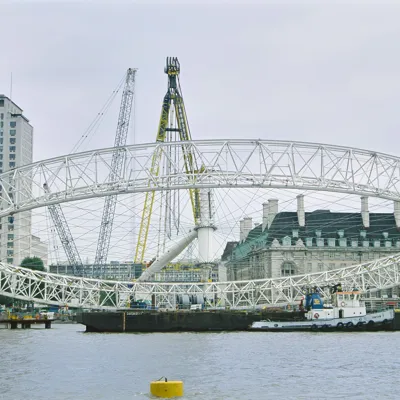
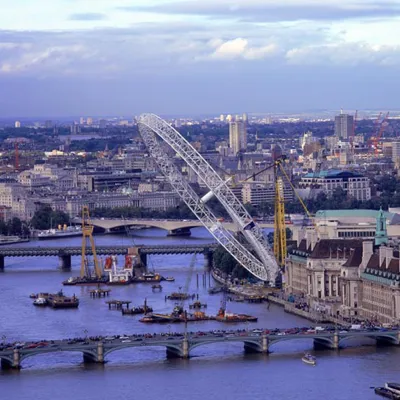
The wheel was assembled flat, then winched upright into position.
-
Marks Barfield Architects sketched around 100 unique design variations.
-
The 32 passenger capsules are numbered 1 to 33, skipping unlucky 13.
-
Each capsule represents one of London's 32 boroughs.
When Was the London Eye Built?
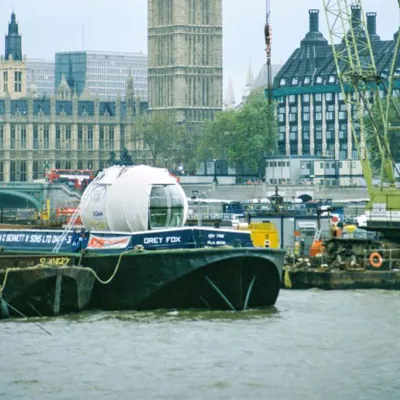
Construction began in 1998, and the London Eye was ‘opened’ by former Prime Minister, Tony Blair in 1999. It welcomed its first passengers in March 2000.
Photo Credit: Lisa Young Photography
Why Was the London Eye Built?
The idea began in 1993, when David Marks and Julia Barfield of Marks Barfield Architects entered a competition for a new landmark to mark the millennium. The competition was sponsored by The Sunday Times and Great Britain's Architecture Foundation.
One of the great London Eye facts is the story that it was originally meant to be temporary. Its popularity with Londoners and visitors changed all that. Today, it's a permanent fixture on the city skyline — a symbol of modern Britain and the centrepiece of the city's New Year celebrations.

Who Designed the London Eye?
David Marks and Julia Barfield of Marks Barfield Architects designed and developed the London Eye. Early planning faced several obstacles, until a journalist at London's Evening Standard uncovered their planning application. The story sparked the 'Back the Wheel' campaign, rallying support across the city. British Airways later came on board with considerable financial backing.
Discover the London Eye
Enjoy one of the world's most iconic rides while soaking up London's beautiful skyline! Get spectacular 360° views of the city, including historic landmarks like St. Paul's Cathedral, Big Ben and the Houses of Parliament. For an extra special day in the city, discover our Champagne Experience and Eye Lounge Experience.
Our Tickets & PricesFAQS
It cost up to £75 million to build the London Eye.
The London Eye opened to the public in March 2000 and celebrated its 25th birthday in 2025.
The London Eye was originally called the Millennium Wheel, and has also had some sponsored names such as the British Airways London Eye and Coca-Cola London Eye.
There are 32 capsules on the London Eye, each representing one of the 32 London boroughs. Each capsule is air-conditioned and made of sealed, oval-shaped glass.
A full rotation of the London Eye takes 30 minutes
Each capsule on the London Eye can hold up to 25 passengers.
The London Eye normally keeps moving slowly enough for guests to board and leave safely at ground level. Guests with accessibility requirements can speak to the team for boarding assistance.
The London Eye wasn’t built from raw materials on site. Large parts were made across Europe, in the Czech Republic, France, Germany, the Netherlands and Italy, and delivered to London ready to assemble. The steel rim arrived in multiple sections, the central axle in large pieces, and the cables were manufactured to exact lengths. Read more in How the London Eye Was Built.
The London Eye is the world’s largest cantilevered observation wheel. Unlike a traditional Ferris wheel, its enclosed capsules sit outside the rim, while the wheel is supported by an A-frame on one side.
